


Last Updated: October 27, 2026
Quick Summary
You can monitor air quality at home for free by using your nose, watching for condensation and mold, checking the Air Quality Index in a weather app or at AirNow, reading local pollution and pollen forecasts, and running a DIY mold test kit. For room-by-room readings, use a test kit or an indoor monitor placed at breathing height.
- Outdoor AQI readings give a regional picture, not a room-by-room one.
- Place monitors at breathing height, away from windows, doors, and air vents.
- A CO2 reading above 1,000 ppm signals poor ventilation; crack a window and run a fan.
- Check the outdoor AQI before opening windows, and log indoor readings at the same time daily.
- Fix one thing per week, then recheck, and clean or replace filters on schedule.
Table of Contents
- Simple Ways to Monitor Air Quality Without Buying a Device
- Choosing an Indoor Air Quality Monitor and Getting Placement Right
- Turning Air Quality Readings Into Action at Home
- Frequently Asked Questions
Simple Ways to Monitor Air Quality Without Buying a Device
You can monitor air quality at home using your senses, public data, and tests.
Free ways to check the air you breathe:
- Use your nose. Smell gas, damp, or chemical odors and act on them.
- Watch for condensation and mold spots on walls, sills, and grout.
- Check the Air Quality Index (AQI) for your area in a weather app or at AirNow's official AQI tool.
- Read the local forecast for pollution alerts and pollen counts.
- Run a DIY mold test kit across several rooms to confirm what your eyes suspect.
Outdoor readings give a regional picture, not a room-by-room one. For indoor air, you need a test kit or a monitor.
A mold test kit is the cheapest way to check a specific worry, covering several areas at once. EPA guidance on mold and moisture recommends fixing the moisture source, not just cleaning the mold.
For gas and carbon monoxide, a dedicated alarm is one option. A mold test kit for up to 6 areas is another way to check for mold.
A monitor is another option, and placement matters. A combined smoke and carbon monoxide detector is another affordable way to watch for combustion-related air risks.
Choosing an Indoor Air Quality Monitor and Getting Placement Right
When choosing a monitor, consider what you want to measure and where you spend time. Placement matters.
What to look for in an indoor air quality monitor:
Household Air Purifier Portable Air Cleaner Mini Desktop Air Purifier With HEPA →
- PM2.5 and PM10 sensors for dust, smoke, and pollen
- CO2 readings to catch poor ventilation in bedrooms and offices
- Gas sensors for carbon monoxide or volatile organic compounds
- A clear display or app so you can read it without a manual
- Data logging to spot patterns over days, not minutes
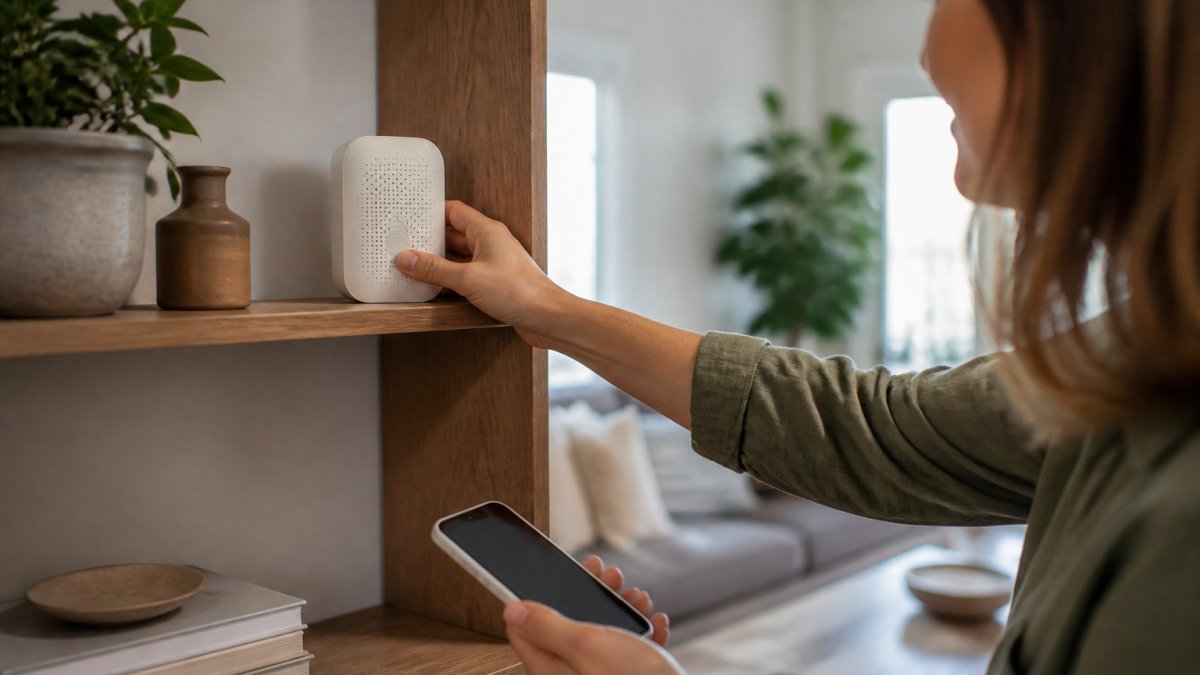
Where to place it:
- Living areas: at breathing height, away from windows and doors.
- Bedrooms: on a nightstand, not under the bed.
- Kitchen: away from the stove.
- Avoid: direct sunlight, radiators, and corners behind furniture.
A common mistake is putting the monitor next to an air vent, so it measures supply air, not the room. Another is checking once and calling it done, air changes all day.
Turning Air Quality Readings Into Action at Home
Readings can help inform what to check next. Consider the reading and recheck.
Match the reading to the fix:
| Reading | Likely cause | Action |
|---|---|---|
| PM2.5 spikes at night | Bedroom dust, candles | Vacuum, add a HEPA purifier |
| CO2 climbs above 1,000 ppm | Poor ventilation | Crack a window, run a fan |
| High humidity, musty smell | Damp or leak | Fix the source, test for mold |
| CO alarm sounds | Combustion problem | Leave, ventilate, call a pro |
A simple weekly routine:
- Check the outdoor AQI before opening windows.
- Note the indoor reading at the same time each day.
- Log any spike and its cause.
- Fix one thing per week, then recheck.
- Clean or replace filters on schedule.
When considering an air purifier for a living space, see the large-room air purifier. For a bedroom or desk, consider the small desktop air purifier, listed at ≤30 dB. A formaldehyde test kit is listed for formaldehyde testing.


For more detail on what each pollutant does, see WHO air quality guidelines.
Frequently Asked Questions
How can I check the air quality in my home without a sensor?
You can monitor air quality without buying a device by checking your local AQI through free apps and government dashboards, watching for signs like condensation, musty smells, or dust buildup, and ventilating rooms daily. A formaldehyde test kit, such as the one from Deposits Back Store at $15.75, is listed for formaldehyde testing. For ongoing tracking, consider an indoor air quality monitor.
Where should I place an air quality monitor for accurate readings?
Place the monitor in a room you use. Consider checking readings in different rooms.
Which is more harmful, PM2.5 or PM10?
PM2.5 and PM10 refer to different particle-size categories. Check the specifications of a monitor to see what it measures. If you are concerned about indoor air quality, consider ventilation or an air purifier.
Most people buy a monitor, watch the numbers move, and change nothing. The gap is not data, it is action. Deposits back store stocks the detection kits and purifiers that close that gap, from CO alarms and radon detectors to HEPA purifiers sized for a bedroom or a full living room. Get started with Deposits back store and turn your readings into a safer home.
