


Last Updated: October 27, 2026
Quick Summary
There is no single best EMF radiation shielding for home use, because the right choice depends on which field you are blocking. Radio-frequency sources like Wi-Fi and 5G respond to conductive fabrics, paints, and mesh, while low-frequency magnetic fields need thick steel or mu-metal instead.
- Copper is the workhorse for RF radiation, available as foil, mesh, or tape.
- Shielding paint only works with conductive primer, full wall coverage, and grounding.
- Magnetic field strength drops sharply as you move away from the source.
- Start retrofit shielding with the bedroom: shield the window and move the router.
- Measure before and after with the same meter to verify any shielding worked.
Table of Contents
- What Is the Best EMF Radiation Shielding for Home?
- How to Measure EMF Radiation at Home
- EMF Shielding Materials for Home
- Shielding Radio-Frequency Radiation
- Shielding Low-Frequency Magnetic Fields
- Home and Architectural Shielding Applications
- Cell Phones, Wi-Fi, and 5G as Exposure Sources
- EMF-Blocking Products and Accessories
- Room-by-Room Home Shielding Plan
- Independent Measurement and Verification
- Evidence Quality and Realistic Claims
- Installation, Grounding, and Safety Considerations
- Frequently Asked Questions
What Is the Best EMF Radiation Shielding for Home?
There is no single best EMF radiation shielding for home use, the right choice depends on which field you are blocking. Radio-frequency sources like Wi-Fi and 5G respond to conductive fabrics, paints, and mesh, while low-frequency magnetic fields need different materials entirely.
How to Measure EMF Radiation at Home
- Map the sources. Note the meter box, Wi-Fi router, smart meter, and motor-driven appliances.
- Log readings at three distances. At the source, one metre away, and where you sit or sleep.
- Re-test at the same time of day. Grid load and wireless traffic both change.
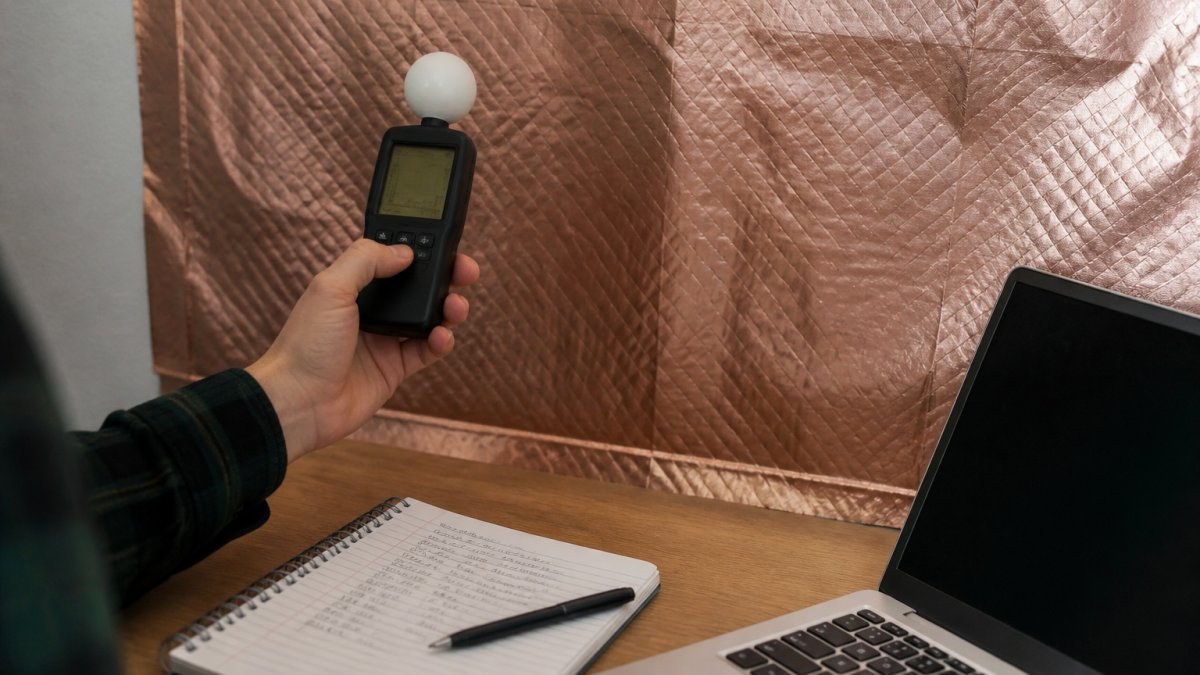
For home readings, the Bside K7 EMF meter, professional handheld gauss and Tesla dosimeter, and simple LCD EMF dosimeter are available.
EMF Shielding Materials for Home
Shielding materials fall into two families, and mixing them up is the most common buying error. Conductive metals (copper, aluminum, nickel, steel mesh) handle radio-frequency radiation, Wi-Fi, cell signals, 5G, RFI/EMI. High-permeability metals handle low-frequency magnetic fields; thin foil does almost nothing, so you need mu-metal or thick steel plate, and the cost climbs fast.
| Material | Best Against | Home Use | Realistic Limit |
|---|---|---|---|
| Copper foil or mesh | RF radiation, Wi-Fi, 5G | Walls, window frames | Needs full coverage and grounding |
| Nickel or copper-nickel fabric | Conductive fabric, curtains | Drapes, blankets, phone sleeves | Wear and washing reduce performance |
| Steel plate | Low-frequency magnetic fields | Beside fuse boxes | Heavy, costly, awkward to fit |
Faraday Fabric and Conductive Textiles
Faraday fabric is woven polyester coated or interwoven with copper or nickel. It blocks radio-frequency signals and is the most practical material for curtains, blankets, and phone cases, flexible, cuttable, affordable. The catch is coverage: a blanket only blocks what it covers, signals enter through gaps, seams, and unshielded windows, and fabric degrades with washing.
Copper, Nickel, Steel, and Aluminum Shielding
Copper is the workhorse for RF radiation, it conducts well, handles a broad frequency range, and comes as foil, mesh, or tape. Nickel adds corrosion resistance, aluminum is lighter and cheaper, and steel is the only one with any real effect on low-frequency magnetic fields, and only in thick sections.
EMF Shielding Paint
Shielding paint contains carbon, graphite, or metal particles and turns a wall into a conductive barrier against RF radiation, suiting whole-room coverage and renovations. It only works as a system: conductive primer, full wall coverage including behind skirting boards, and grounding.
EMF Shielding Curtains
Shielding curtains made from conductive fabric reduce RF radiation through windows, the biggest leak point in most homes, and are the easiest retrofit option. Expect partial reduction, not a sealed room: curtains must overlap at the edges and cover the full window opening, or signal passes straight through.
Shielding Radio-Frequency Radiation
Radio-frequency radiation is the easiest field to block: Wi-Fi, cell signals, and 5G sit at high frequencies where thin conductive materials work well, and a single layer of copper mesh or conductive fabric can cut a large share of the signal.
Shielding Low-Frequency Magnetic Fields
Magnetic fields are the hard problem most guides skip: power lines, wiring in walls, fuse boxes, and transformers produce low-frequency fields that pass straight through foil, paint, and fabric. Distance is the cheapest fix: magnetic field strength drops sharply as you move away from the source.
Home and Architectural Shielding Applications
Architectural shielding builds the barrier into the structure: conductive paint under plaster, grounded mesh in walls and ceilings, and shielded window film or glass. It delivers the most complete coverage and suits renovations and new builds. Retrofit shielding works room by room: start with the bedroom, shield the window, move the router, address the fuse box, then measure again.
Cell Phones, Wi-Fi, and 5G as Exposure Sources
The devices closest to you matter more than the tower down the road: a phone held to your head exposes you to more RF radiation than a router across the room, Wi-Fi adds continuous low-level exposure overnight, and 5G's shorter range means indoor exposure usually comes from your own router and handset.
EMF-Blocking Products and Accessories
Accessories are the cheapest entry point, and the easiest to over-buy. Phone cases, sleeves, blankets, canopy nets, and curtains all use conductive fabric to reduce exposure at the point of contact. Judge them on material composition, stated attenuation, and coverage: a case that shields the back of a phone does little if the front faces your body, and a blanket only works over the area it covers.
Room-by-Room Home Shielding Plan
- Bedroom. Shield the window, relocate the router, phones in airplane mode overnight.
- Living room. Move the router to a central, low-traffic spot; shield walls shared with a fuse box.
- Home office. Ground your desk setup; keep the router a metre from where you sit.
- Kitchen and utility room. Check appliances and the meter box, where magnetic fields are strongest.
- Nursery. Shield the window, keep baby monitors at a distance, re-measure after every change.
Independent Measurement and Verification
Verification separates real shielding from marketing claims: measure before, measure after, and keep the numbers. A material that claims strong attenuation means nothing without a reading taken in your own home. Test at the same distance, time of day, and with the same meter, recording the source, reading, and material used.
Evidence Quality and Realistic Claims
Treat shielding claims with skepticism, including our own. A product that blocks a large share of radiation in a lab test may perform far worse in a room with gaps, seams, and unshielded windows. Coverage and grounding decide the result, not the material alone.
Installation, Grounding, and Safety Considerations
Deposits back store offers environmental detection kits, EMF radiation detectors, and home safety equipment.
Frequently Asked Questions
Does EMF house shielding work?
EMF house shielding can reduce exposure, but how well it works depends on the material and the type of field. Conductive materials like copper, nickel, and aluminum block radio-frequency radiation from Wi-Fi and cell signals. Low-frequency magnetic fields from wiring are harder to block and may need distance or source removal. Measure EMF levels before and after installation to confirm the reduction, and remember that no shielding removes all exposure.
What materials can shield a home from EMF?
Common EMF shielding materials for home use include copper, nickel, steel, and aluminum, often as solid sheets, mesh, or conductive fabrics like Faraday fabric. For radio-frequency radiation, these metals reflect or absorb signals. For low-frequency magnetic fields, steel and mu-metal offer some attenuation but are less effective. EMF shielding paint with carbon or metal particles and EMF shielding curtains with conductive threads are practical options for walls and windows.
Should I measure EMF levels before installing home shielding?
Yes, measuring first is essential. A handheld EMF meter helps you identify which areas have the highest exposure and which field types are present, so you can target shielding where it matters. Without baseline readings, you risk buying materials that do not address the actual source, or over-shielding a low-risk area. Take measurements at different times of day and near windows, walls, and appliances to get a clear picture before you spend money.
