


Last Updated: October 27, 2026
Quick Summary
To judge gasdog vs detekt sensor reliability, run a repeatable response-time test: fix a test spot, record conditions, time the alarm, and repeat three times. Average the readings and compare across months, since a response time that drifts longer signals a fading sensor.
- A 50-1000 ppm range states what a sensor can register, not how precisely it reads.
- Test the alarm every 3 months and check or swap batteries every 6 months.
- Natural gas and methane rise, so those detectors belong high near the ceiling.
- Propane and LPG settle low, so those units go near the floor.
- A shorter stated sensor life costs more per year even at a lower sticker price.
Table of Contents
- Why Gasdog vs Detekt Sensor Reliability Is Hard to Judge From a Spec Sheet
- Home Natural Gas Leak Detector Accuracy: What the Numbers Actually Mean
- How to Test a Gas Leak Detector: A Repeatable Response-Time Check
- Gas Detector Sensor Lifespan and the Maintenance Schedule That Protects It
- Natural Gas Leak Detector Placement: Where Reliability Is Won or Lost
- Choosing Your Detector on Deposits Back Store
- Frequently Asked Questions
Why Gasdog vs Detekt Sensor Reliability Is Hard to Judge From a Spec Sheet
The gasdog vs detekt sensor reliability review question rarely gets a straight answer because both names appear on near-identical spec sheets. Model numbers, ppm ranges, and "high sensitivity" claims tell you what a sensor is rated to do, not how it performs in a drafty kitchen, and that gap is where most buying mistakes happen.
A fair Gasdog-versus-Detekt comparison rests on three checkable things: published detection specs, sensor technology, and behavior under a repeatable bench test you run yourself.
At Deposits back store, we offer gas leak sensors and environmental detection kits. Below: what the numbers mean, how to run a response-time check, and where placement and maintenance matter.
Home Natural Gas Leak Detector Accuracy: What the Numbers Actually Mean
Home natural gas leak detector accuracy describes how close a reading gets to the true gas concentration, and a single "accuracy" figure on a box almost never tells you that. Most consumer units quote a detection range and a sensitivity threshold instead. A 50-1000 ppm range states what the sensor can register, not how precisely, different promises.
Detection Threshold and Gas Compatibility
Gas compatibility matters as much as threshold. Matching the sensor to the gas you actually want to monitor is the first reliability decision, and it happens before you spend anything.
False Alarms and Missed Detections
False alarms and missed detections are the two failure modes that matter. A unit that shrieks at cooking spray trains you to ignore it; one that stays silent near a real leak is worse. Reliability is the balance between the two, set by sensor quality, threshold tuning, and how faithfully you follow the maintenance schedule.
How to Test a Gas Leak Detector: A Repeatable Response-Time Check
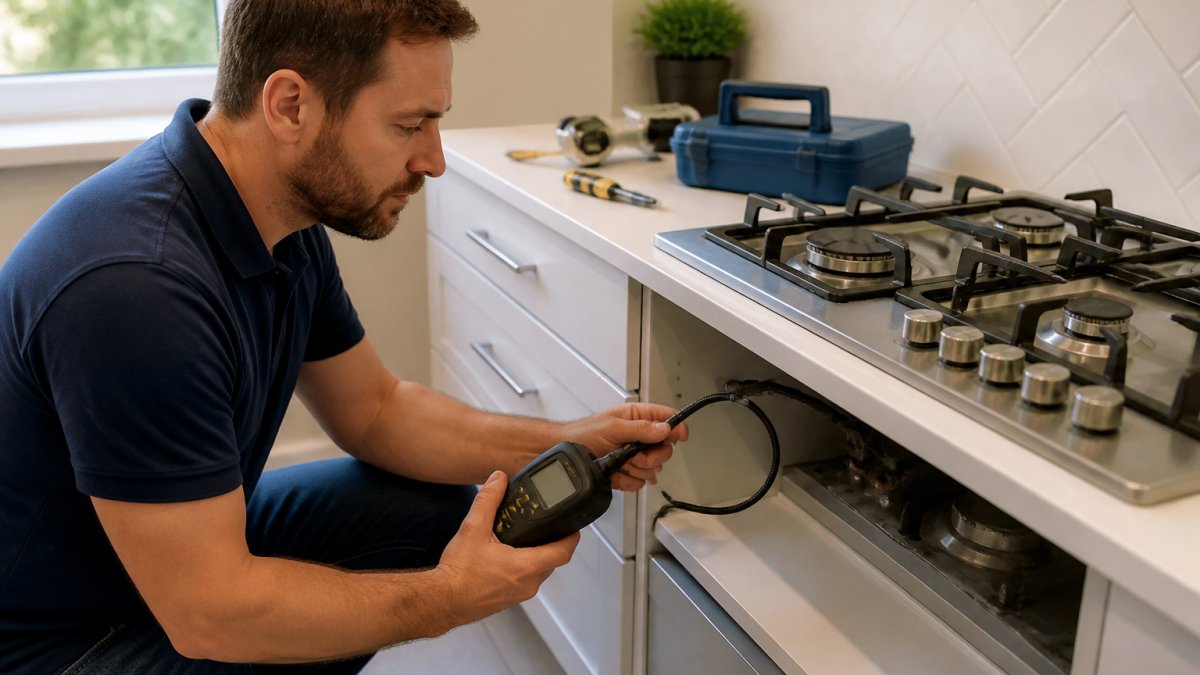
- Pick a fixed test spot. A kitchen hob with a burner you can crack open slightly works well. Mark the distance from the burner to the sensor probe with tape so every run matches.
- Note the conditions. Record room temperature, whether a window is open, and battery level. These change response time.
- Time the alarm. Start a stopwatch the moment you open the gas, stop it when the unit alarms, and write the number down.
- Repeat three times. Average the three readings. A single run tells you little.
- Compare across months. A response time that drifts longer over successive tests is your early warning that the sensor is fading.
Our combustible gas leak detector for natural gas and methane has a 50-1000 ppm detection range and an LCD screen. Its power supply is 2 AAA alkaline batteries, which are not included.

Gas Detector Sensor Lifespan and the Maintenance Schedule That Protects It
Gas detector sensor lifespan is the reliability factor buyers underestimate most, and where a Gasdog-versus-Detekt comparison quietly gets decided. Sensing elements degrade with contaminants, humidity, and time, so a unit that tested well on day one can drift within a couple of years. The fix is a maintenance schedule you actually follow, not a promise on the box.
What Actually Ages a Sensor
Sensitivity fades gradually rather than failing outright, the unit still alarms, just later and at a higher concentration. That is why a response-time test that drifts longer over successive months beats a pass/fail check.
2025 Newest Combustible Gas Leak Sensor Detector Natural Gas Methane Gas Leak →
Calibration: What You Can and Cannot Do at Home
True calibration means exposing the sensor to a known concentration of certified test gas and adjusting the reading to match. Most consumer units expose no user calibration function, and certified span gas is rarely economical for one household detector. What you can do at home is a functional check: confirm the unit still alarms within its expected window under your repeatable test conditions. If it does not, the unit is out of service, do not "recalibrate" by trusting it harder.
A Maintenance Schedule You Will Actually Keep
| Task | Frequency | Why It Matters |
|---|---|---|
| Response-time test | Every 3 months | Catches drift before it becomes a missed detection |
| Battery check or swap | Every 6 months | Weak batteries slow alarm response and can cause false low-battery chirps |
| Sensor cleaning per manual | Per manufacturer guidance | Contaminant buildup dulls sensitivity; follow the manual, not a home remedy |
| Full unit replacement | Per manufacturer's stated sensor life | Aging sensors fail quietly, not loudly |
| Log review | Every test | A written history is the only way to spot a slow drift trend |
The Ownership-Cost Angle Competitors Skip
Reliability has a running cost, and it rarely makes it into a Gasdog-versus-Detekt review. A detector with a shorter stated sensor life costs more per year of protection even if its sticker price is lower. Before buying either unit, note the stated sensor life, battery type and replacement interval, and whether the sensor is field-replaceable or the whole unit must be swapped. A unit needing full replacement every two years is not cheaper than one that lasts five, even at half the price, the reliability question is an economics question too.
Natural Gas Leak Detector Placement: Where Reliability Is Won or Lost
Natural gas leak detector placement decides whether a perfectly good sensor ever gets a chance to work. Natural gas and methane rise, so those detectors belong high, near the ceiling or above the appliance. Propane and LPG are heavier than air and settle low, so those units go near the floor. Put a propane detector at ceiling height and it reads clean while gas pools below it.
Placement by Gas Type
- **
- **
- **
- **
The HYTAIS TS20E combustible gas detector is listed as a combustible gas detector with an LCD screen.

Choosing Your Detector on Deposits Back Store
Browse environmental detection kits for the home to explore the available range.
Deposits back store offers environmental detection kits and specialized home safety equipment to help you monitor home safety and detect environmental hazards.
Frequently Asked Questions
Is Gasdog or Detekt more reliable for detecting gas leaks?
Deposits back store offers gas leak sensors, including a combustible gas leak detector with a listed detection range of 50-1000 ppm. Check the product listing for its detectable gases and specifications.
How accurate are home natural gas leak detector accuracy claims in practice?
The Deposits back store combustible gas leak detector listing gives a detection range of 50-1000 ppm. Check the product listing for its specifications.
How long do gas leak detector sensors last?
Most electrochemical and semiconductor sensors degrade over time, and many manufacturers rate them for roughly three to five years of normal use. Gas detector sensor lifespan shortens with exposure to high concentrations, humidity and temperature swings. Log the purchase date, test monthly, and replace the unit or sensor at the interval the listing states. A detector that still powers on is not proof the sensor still works.
Where should you place a home gas leak sensor?
Natural gas leak detector placement depends on the gas. Methane and natural gas rise, so mount the detector high on a wall or near the ceiling, within a few metres of the boiler, hob or gas meter. Propane and LPG are heavier than air and settle low, so place those units near floor level. Keep units away from drafts, cooking steam and open windows, and test the spot with a known source before relying on it.
